
Blog
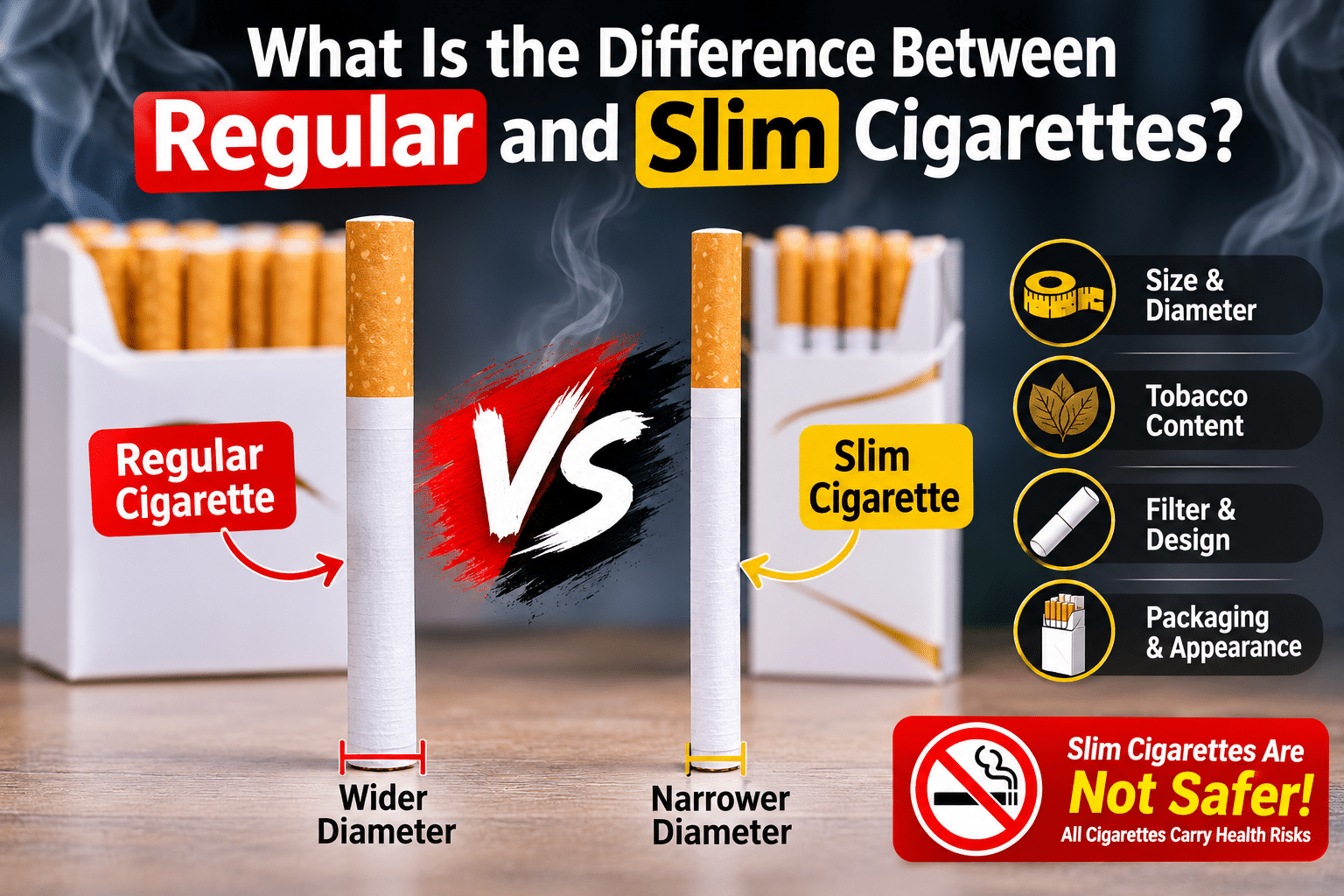
What Is the Difference Between Regular Vs Slim Cigarettes?

What Is the Difference Between Regular Vs Slim Cigarettes?
Cigarettes come in several formats, and their physical appearance can vary widely across product lines. Two commonly discussed formats are regular and slim cigarettes. Although both contain tobacco and use similar basic components, they differ in diameter, overall construction, filter proportions, and external appearance.
Understanding the difference between regular and slim cigarettes requires looking beyond their visual design. Dimensions, tobacco composition, packaging, and product specifications can vary by manufacturer. This guide explains the main distinctions and addresses some common misunderstandings about cigarette size and health risks.
What Are Regular Cigarettes?
Regular cigarettes are the conventional cigarette format commonly found across international tobacco markets. They generally have a wider cylindrical structure, with a tobacco-filled section wrapped in cigarette paper and a filter attached to one end.
Dimensions vary by manufacturer and product range. Standard and king-size formats are common, though exact measurements vary by brand.
For instance, Davidoff Classic Cigarettes and Camel Blue Cigarettes are conventional cigarette listings with their own product specifications.
Some characteristics of regular cigarettes include:
- Generally wider diameter than slim formats.
- Conventional cylindrical construction.
- Tobacco quantity varies by product.
- Available with different filter designs.
- Packaging and cigarette length vary by manufacturer.
What Are Slim Cigarettes?
Slim cigarettes have a narrower diameter than conventional cigarette formats. Their thinner construction gives them a visibly different appearance, even though they contain the same basic components found in other combustible cigarettes.
The slim format is available across several international tobacco brands. Some products are also marketed as super slim, meaning an even narrower design.
The MyCig cigarette range includes Davidoff White Slim Cigarettes and Davidoff Gold Slim Cigarettes.
Other examples include Vogue Frisson Menthol Cigarettes and ESSE Change Cigarettes.
Common physical characteristics of slim formats include:
- Narrower diameter compared with regular formats.
- Thinner tobacco rod construction.
- Different proportions between the filter and tobacco sections.
- Distinctive packaging designs.
- Product dimensions that vary by brand.
Importantly, the word slim describes the physical format. It does not indicate how much nicotine or other harmful substances a person receives.
Regular vs Slim Cigarettes: Key Differences
Although both formats share the same fundamental construction, several physical and technical details distinguish them.
Size and Diameter
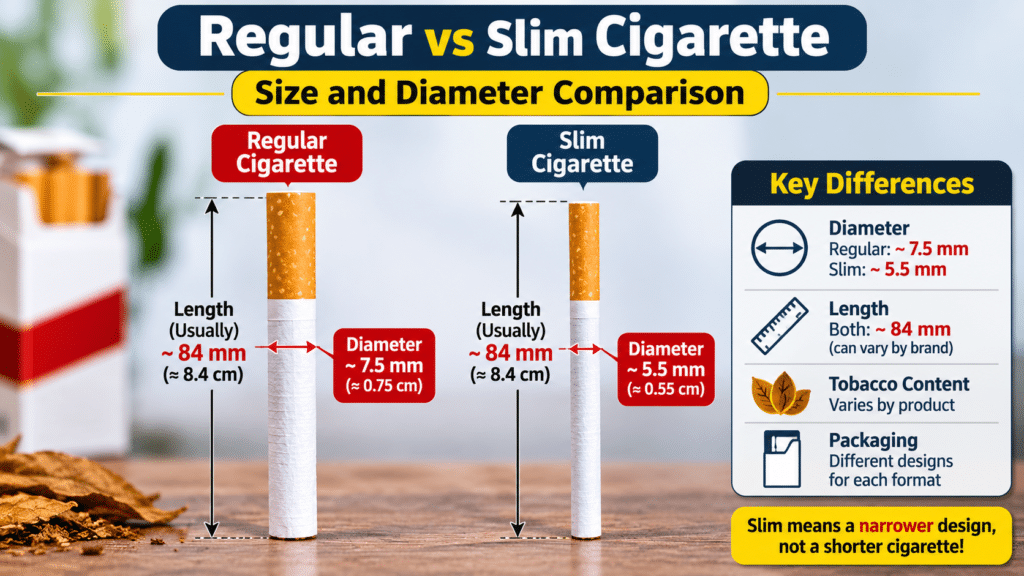
The most noticeable difference is the diameter.
Regular cigarettes generally have a wider circumference, while slim cigarettes use a narrower cylindrical structure. This distinction affects their overall appearance and the dimensions of the tobacco rod.
Cigarette length is a separate measurement. A slim cigarette is not necessarily shorter than a regular cigarette. Some slim products are available in longer formats.
Tobacco Content
Tobacco quantity can differ between regular and slim cigarettes because their physical dimensions are different.
However, diameter alone cannot establish the exact tobacco weight or composition. These details depend on the manufacturer’s specifications, tobacco blend, and construction.
A narrower cigarette should not automatically be assumed to contain a particular amount of nicotine or tar.
Filter and Design
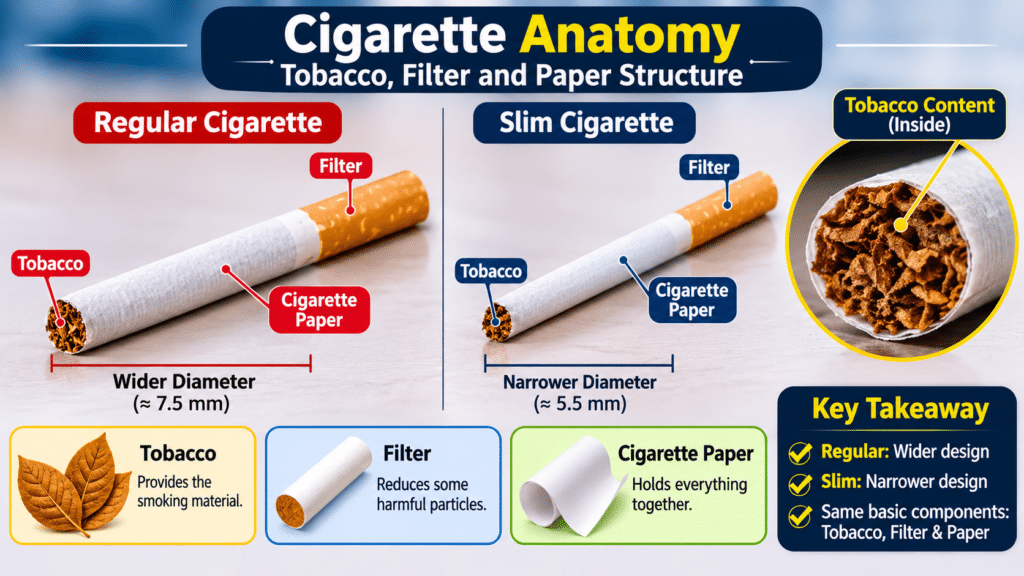
Both formats can include filters, but their proportions and construction may differ.
Filter diameter generally corresponds to the cigarette’s overall width. Manufacturers may also use different filter materials, ventilation arrangements, and paper designs.
Consequently, a filter’s appearance does not provide enough information to determine a cigarette’s full technical specifications.
Packaging and Appearance
Packaging is another noticeable distinction.
Regular cigarettes commonly use conventional rectangular packs designed around standard cigarette dimensions. Slim cigarette products may use packaging sized for their narrower format.
For example, manufacturers may distinguish between standard and slim variants through product names, packaging layouts, and printed specifications.
These differences mainly relate to product identification and presentation.
Comparison Table: Regular vs Slim Cigarettes
| Feature | Regular Cigarettes | Slim Cigarettes |
| Diameter | Generally wider | Generally narrower |
| Construction | Conventional format | Slim cylindrical format |
| Tobacco Quantity | Varies by product | Varies by product |
| Filter | Different designs available | Different designs available |
| Length | Depends on the variant | Depends on the variant |
| Packaging | Conventional pack format | May use different proportions |
| Product Dimensions | Brand-specific | Brand-specific |
Are Slim Cigarettes Less Harmful Than Regular Cigarettes?
This matters because the narrower look of slim cigarettes can create a misleading impression about their health effects.
Slim cigarettes are not a safer alternative to regular cigarettes.
Both formats involve burning tobacco and producing smoke containing harmful chemicals. A smaller diameter or different filter design does not eliminate the health risks associated with smoking.

According to the National Cancer Institute, cigarettes marketed as light or low-tar are not safer than conventional cigarettes. Changes in cigarette design do not reliably reduce the risk of smoking-related diseases.
The same principle applies when interpreting physical differences between slim and regular formats. Appearance should never be confused with reduced health risk.
Smoking is associated with serious conditions, including lung cancer, cardiovascular disease, and respiratory illnesses. Avoiding tobacco or quitting smoking is the most effective way to reduce these risks.
Why Do Cigarette Manufacturers Produce Different Sizes?
Different cigarette formats are part of the broader product design and manufacturing process.
Manufacturers develop different dimensions, filters, and packaging configurations for individual product ranges. These decisions can involve production specifications, packaging requirements, and regional product variations.
For example, the MyCig cigarette collection includes different brand families and variants, such as Winston Blue Cigarettes and other internationally recognized product names.
Treat each listing separately because one variant’s specifications don’t automatically apply to another product from the same brand.
Frequently Asked Questions
What is the main difference between regular and slim cigarettes?
The main difference is their physical diameter. Regular cigarettes are generally wider, while slim cigarettes are narrower.
Are slim cigarettes shorter than regular cigarettes?
Not necessarily. Slim refers to diameter, not length. Slim cigarettes can vary in length depending on the manufacturer’s specifications.
Do slim cigarettes contain less tobacco?
Tobacco quantity varies between products. A narrower diameter may affect the amount of tobacco used, but manufacturers’ specifications confirm the exact quantity.
Are slim cigarettes safer than regular cigarettes?
No. Slim cigarettes are not a safe alternative to regular cigarettes. Both expose users to harmful chemicals associated with tobacco smoke and serious health conditions.
What should be checked when comparing different cigarette formats?
Check the complete product name, dimensions, filter construction, pack quantity, and manufacturer information. These details provide a more accurate understanding of how products differ.
Final Thoughts
Regular and slim cigarettes share the same basic combustible tobacco construction, but differ in physical dimensions and external presentation. Regular formats generally have a wider diameter, while slim formats are narrower.
Other characteristics, including cigarette length, tobacco quantity, filter construction, and packaging, vary by manufacturer and product variant.
When researching these products, distinguish between physical design and health-related claims. A slimmer appearance does not make a cigarette safer, and all combustible tobacco products carry significant health risks.